Pearson Edexcel · GCSE · Psychology
Course version: 1PS0 · Version from Sept 2017
Sleep and dreaming - 9.2 Studies: 9.2.2 Siffre (1975) Six months alone in…
Full specification wording
Topic 9: Sleep and dreaming - 9.2 Studies: 9.2.2 Siffre (1975) Six months alone in a cave
Michel Siffre spent six months in a cave to study the effects of isolation on the sleep-wake cycle, without external time cues like daylight or clocks.
Checked against the Pearson Edexcel 1PS0 specification (opens in a new tab) on .
- Point 2 of 2
- 3 key terms
Study notes
From the checked teaching notes for this specification point.
The idea
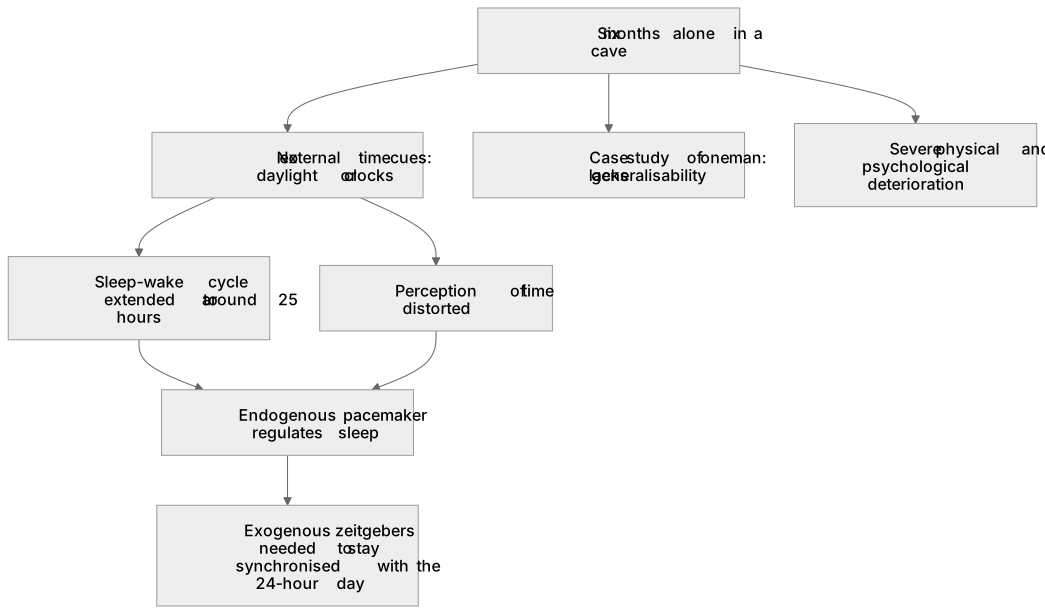
Michel Siffre spent six months in a cave to study the effects of isolation on the sleep-wake cycle, without external time cues like daylight or clocks. He found that his circadian rhythm extended from a 24-hour cycle to approximately 25 hours. His perception of time was also distorted; he believed he had been in the cave for a shorter period than he actually had. This demonstrated that the human body has an internal pacemaker (endogenous pacemaker) regulating sleep, but it requires external cues (exogenous zeitgebers) to stay synchronised with the 24-hour day. As a case study of one man, it lacks generalisability, and Siffre experienced severe physical and psychological deterioration during the isolation.
What earns the marks
- Identify the aim: to investigate the natural sleep-wake cycle without external time cues.
- Describe the method: a six-month case study in a cave without natural light or clocks.
- State the findings: his sleep-wake cycle extended to around 25 hours, and time perception was distorted.
- Explain the conclusion: endogenous pacemakers control the sleep-wake cycle but need exogenous zeitgebers to maintain a 24-hour rhythm.
- Evaluate the study: strengths include detailed longitudinal data; weaknesses include lack of generalisability and psychological distress.
Common mistakes and how to put them right
Believing Siffre's sleep cycle shortened.
Put it right: His sleep-wake cycle actually lengthened to around 25 hours.
Thinking Siffre had no light at all.
Put it right: He had artificial light, which may have acted as a confounding variable affecting his circadian rhythm.
Confusing endogenous and exogenous factors.
Put it right: Endogenous pacemakers are internal biological clocks, whereas exogenous zeitgebers are external environmental cues like sunlight.
Exam tips
- Use the terms 'endogenous pacemaker' and 'exogenous zeitgeber' accurately when explaining Siffre's conclusions.
- Remember that as a case study of one individual, the findings cannot be easily generalised to the wider population.
- Be prepared to evaluate the ethics of the study, noting the severe psychological and physical toll the isolation took on Siffre.
Try the lesson
The start of the Topic 9: Sleep and dreaming - 9.2 Studies: 9.2.2 Siffre (1975) Six months alone in a cave lesson, made from checked teaching notes for this specification point.
Have a go first
What was the main aim of Siffre's (1975) study where he spent six months alone in a cave?
Listen
Michel Siffre spent six months in a cave to study the effects of isolation on the sleep-wake cycle, without external time cues like daylight or clocks. He found that his circadian rhythm extended from a 24-hour cycle to approximately 25 hours. His perception of time was also distorted; he believed he had been in the cave for a shorter period than he actually had. This demonstrated that the human body has an internal pacemaker (endogenous pacemaker) regulating sleep, but it requires external cues (exogenous zeitgebers) to stay synchronised with the 24-hour day. As a case study of one man, it lacks generalisability, and Siffre experienced severe physical and psychological deterioration during the isolation. A strong answer earns marks for these points. Identify the aim: to investigate the natural sleep-wake cycle without external time cues. Describe the method: a six-month case study in a cave without natural light or clocks. State the findings: his sleep-wake cycle extended to around 25 hours, and time perception was distorted. Explain the conclusion: endogenous pacemakers control the sleep-wake cycle but need exogenous zeitgebers to maintain a 24-hour rhythm. A common slip: Believing Siffre's sleep cycle shortened. Instead, His sleep-wake cycle actually lengthened to around 25 hours. Exam tip: Use the terms 'endogenous pacemaker' and 'exogenous zeitgeber' accurately when explaining Siffre's conclusions.
See it
Key words
Say what each word means before you turn the card.
Endogenous pacemaker
Try answering aloud or in your head before turning the card.
Exogenous zeitgeber
Try answering aloud or in your head before turning the card.
Case study
Try answering aloud or in your head before turning the card.
See every definition
- Endogenous pacemaker
- An internal biological clock that regulates the sleep-wake cycle, as shown by Siffre's body continuing a rhythm without external time cues.
- Exogenous zeitgeber
- An external environmental cue such as sunlight that the body needs to stay synchronised with the 24-hour day.
- Case study
- A study of one individual, such as Siffre alone in a cave, which lacks generalisability to the wider population.
Label the diagram
Some boxes have lost their names. Pick the right name for each number.
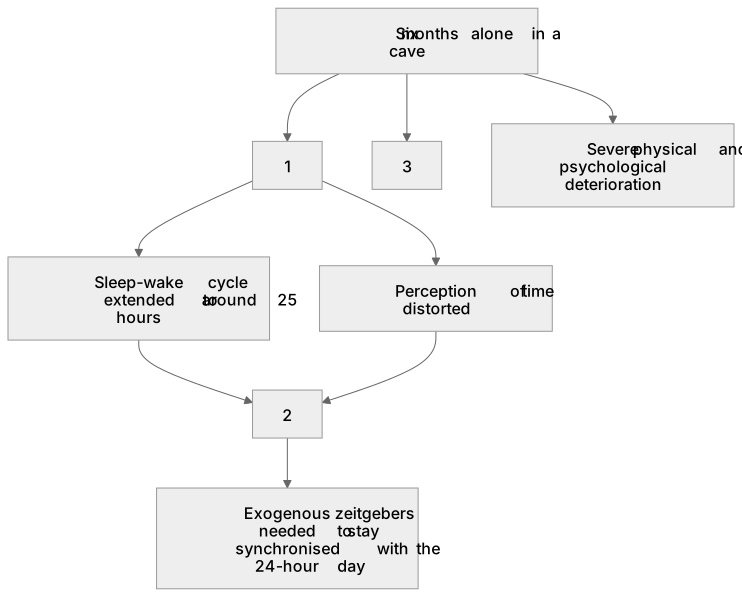
1Box 1
2Box 2
3Box 3
There is more to this lesson
The full lesson goes on to check your understanding and help you earn the marks. Create a free account to carry on, with your progress saved.
A week of Premium from your first lesson · Then the free plan continues · No card, no charge
Test your understanding of Topic 9: Sleep and dreaming - 9.2 Studies: 9.2.2 Siffre (1975) Six months alone in a cave
Active recall beats re-reading. Take an instant quiz now to test what you’ve learned and lock it into long-term memory.
A week of Premium from your first lesson · Then the free plan continues · No card, no charge